Saturday, February 04, 2012

In Pink

http://ecx.images-amazon.com/images/I/41DYVM4N6JL._SL500_AA300_.jpg
Years before Harlem reared rapper Cam'ron began rocking pink like some kind of uptown Mary Kay cosmetic chick, the hue belonged to my man Jesse Johnson who chose the color after Prince opted for the purple material. Back in the day, when I still lived in Washington Heights and watched BET in the middle of the night on UHF, it was all about Prince and the synth-funk-rock of the Minneapolis sound.

It seemed as though every few months a different side project (Apollonia 6, The Family) was launched or another disgruntled employee (Andre Cymone, Terry Lewis & Jimmy Jam) was striking out on their own. As a fan of Prince and everything he ever touched or influenced , I felt obligated to buy them all. At the height of my fandom in 1984, the same year Purple Rain was released, Jesse Johnson broke away from The Time, holed himself up in the studio and crafted his dope debut The Jesse Johnson Review. Released in 1985, the album contained "Be Your Man," "Can You Help Me" and "I Want My Girl," songs I played continuously in my cluttered bedroom.

Last January, when Wax Poetics editor-in-chief sent me an email telling me about the special Prince issue they were planning, he asked who I'd like to interview. The first person who popped into my mind was Jesse Johnson, and I figured I'd go through a Google search and try to track him down. Yet, as luck would have it, a few days later my friend Dyana Williams, a Philadelphia disc jockey who co-hosts the weekly Soulful Sundays with Derrick Sampson on 100.3 WRNB, blasted on Facebook that Jesse was going to be on her show.

Calling her a few minutes later, Dyana introduced me to Jesse's manager Mark via email that same day. Mark told me Jesse would be playing at the Hard Rock Cafe over MLK week-end. While the venue was a strange place for a concert, and the headliner was a little awkward in the beginning, Johnson soon got into the groove and it was funky sailing. Unfortunately, about an hour into his set, the Hard Rock decided it was time for us to leave and killed Jesse's sound in the middle of the show.

Although forced from the stage, Jesse refused to be bum rushed from the backstage area. For the next hour he signed autographs, took pictures with fans and chatted with everybody as though we were all friends and family. Outside it was one of the coldest nights of the winter and a ice storm was brewing, but backstage I was smiling from the warmth that radiated from the people in that room, especially Jesse.

http://www.jessejohnson.com/Images/JessePhilly.jpg

The following day, Jesse and I sat in Dyana's townhouse, where she prepared us lunch, and talked about his life and career. For 90 minutes, Jesse talked about guitar craft, living with Prince, playing on the road, experimenting in the studio, working with filmmaker John Hughes, his friendship with engineer Susan Rogers, recording the then-new Time (Original 7ven) album and jamming with his old Newport smoking friend D'Angelo--who he is currently playing with in Europe. Although not as long my previous Wax Poetic pieces on Barry White, Nina Simone and Curtis Mayfield, one of Jesse's favorite guitar players, he was generous with his time, straight-up with his answers and gave me the interview I had imagined since the eighties.

http://www.weedfarm.com/images/otherimages/CV6079.jpg

Prince fans who peep the cover of the new and improved Wax Poetics (or, WP) are bound to be excited by the 1999 era photo of the purple maestro. Shout-out to fellow scribes Miles Marshall Lewis (Madhouse), Erika Blount (Andre Cymone) and Dean Van Nguyn (Morris Day), who have all been waiting patiently for this issue to rear its pretty face.


http://www.waxpoetics.com/blog/news/...ar-anniversary

Jesse Johnson: http://www.jessejohnson.com/index.html

Labels: , , , , ,

Tuesday, September 06, 2011

Nina Simone/Wax Poetics #48

http://images.hhv.de/catalog/detail_big/00251/251071.jpg
Natural Fact
a cover story on the legendary Nina Simone
by Michael A. Gonzales

For more info, go to: : Afro.astro.channel
For Wax Poetics:
http://www.waxpoetics.com/wax-poetics-magazine/issue-48

Labels: , , ,

Saturday, August 20, 2011

Afro.Astro Channel Meets Michael A. Gonzales

http://caribbeanpost.files.wordpress.com/2010/05/jean_michel_basquiat.jpg
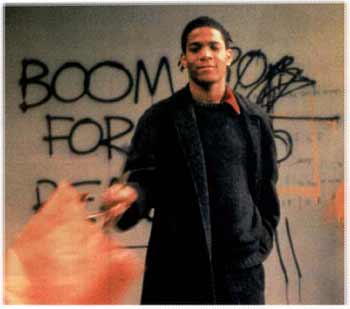
My talented friend and fellow writer Jake-Ann Jones recently interviewed me for her illmatic blog Afro-Astro.Channel. For hours we rapped about my obsessions with funk, Jean-Michel Basquiat, Black rock, Nina Simone and, of course, writing. Recently I wrote about B. in "Black Polaroids on Planet Pop," an essay published in the Dublin-based magazine One More Robot and I'm currently working on another article about Basquiat to be published in the fall.

My upcoming cover story on the great singer Nina Simone will be published in the upcoming Wax Poetics #48, due sometime before the end of the month.
While it would've been difficult to write about Simone's entire life in a magazine piece, my story "Between the Keys" concentrates on her political and personal transformation from naive country girl to a "rhythmic rebel" after befriending playwright Lorraine Hansberry and the New York City crew of Black intellectuals that included James Baldwin and LeRoi Jones.

In addition, the piece explores the real sisterhood she shared with Hansberry, author of
A Raisin in the Sun, and how their friendship helped shape Simone's music, stage persona and personality. For the story, I interviewed Simone's daughter Lisa Celeste Kelly, who has done tributes to her mother under the name Simone, as well as friends and fans Amiri Barakka, Asha Bandele, David Nathan, Dyana Williams, N'Dambi Blue, Alicia Keys, Mister Mann Friby and others.

I'd like to thank my friends Devin Roberson, Asia Minor, Serena Kim and Tomika Anderson, all who helped guide me on the the road to Simone years ago. While I've written many profiles and essays, this 6,000-word piece has a special place in my personal canon. Big-up to Wax Poetics editors Andre Torres and Brian DiGenti for allowing me the space to do Simone right. In the usual Wax Poetics style, the vintage pictures are simply beautiful.

http://www.metascholar.org/highlander/photographs/sources/p2-si1-1.jpg

To access the interview with Gonzo: Afro.astro.channel

For Wax Poetics:
http://www.waxpoetics.com

For the Nina Simone website:
http://www.ninasimone.com

Labels: , , , ,

Monday, July 25, 2011

Joi: Amoeba Cleansing Syndrome

Writer's Note: Joi has been one of my favorite artists since she debuted in 1994 with the groundbreaking Pendulum Vibe. Both on stage and in the studio, Joi continuously brings her own special brand of excellence to the rocking soul scene. This piece was written originally last year for Wax Poetics #42 and it's my pleasure to share it with you now.

http://3.bp.blogspot.com/_12tcNMk5_G0/SPhA5HYgeRI/AAAAAAAAAg4/WJSTTWtBpMc/s200/joi.jpg
http://static.rateyourmusic.com/album_images/b0db1852d52b9915bf4d612168bef679/228171.jpg

Joi
Amoeba Cleansing Syndrome

In the 1990s, Atlanta was a hothouse of post-new jack swing R&B. Yet, while most producers were content making safe Black pop for the masses, Dallas Austin wanted to be an auteur. While he’d constructed platinum selling singles for ABC, TLC, and Boyz II Men, the wicked keyboardist had grown-up admiring the artistry of Prince’s cyberfunk manifesto 1999, wanted to make a difference.

“You’ve got to do what people want you to do before you can do what you want to do,” Austin said in 1992. Two years later, he introduced the world to glam singer Joi. A lipstick liberator in the age of prefab divas, her 1994 debut The Pendulum Vibe was a wonderful introduction to an arty funk-rock aesthetic.

Still, it was Joi’s sophomore joint Amoeba Cleansing Syndrome that was supposed to set the world on fire. “My vision was simple,” she explained in 1997. “I want to do funky, ground-breaking stuff.” Although Joi, who has sung with OutKast and Curtis Mayfield, had no problem referring to herself as R&B, her style was as influenced by the sci-fi imaginary of Barbarella and P-Funk as she was by midnight wail of Gladys Knight.

Recruiting wild boys Fishbone to serve as backing her band, Joi returned to the studio with Austin (more co-conspirator than Svengali), Organized Noize, Whild Peach and boyfriend Big Gipp, who contributed country-ass adlibs to the upbeat radio single “Ghetto Superstar.”

“We are here to take you on an aural expectation,” Joi says on the introduction “Welcome Amoeba Spirit,” before kick starting the disc with the booming “Move On,” which combines gutbucket soul, rock guitars and Paradise Garage grooves. Later, Joi shows her true colors by segueing into a mighty cover of Betty Davis’s “If I’m Lucky (I Might Get Picked Up).”

“I heard George Clinton talking about Davis’s work, but it was actually Fishbone member JB who played me her songs,” Joi said. In addition, she covered Labelle’s raunchy “You Turn Me On,” a song from their acclaimed Nightbirds. “Labelle was like superheroes to me.”

Writing lyrics for all original material, Joi could be so revealing she sounded naked. On the bluesy “Hurt Sometimes” and the orgasmic “Dirty Mind,” she flaunts her freak flag without shame. Yet, when teaming with sonic architects Organized Noize (Dudgeon Family) on the psychedelic “Dandelion Dust,” she sounds fragile as Liz Fraser from the Cocteau Twins.

Too cutting edge for Joi’s original label EMI, Amoeba Cleansing Syndrome was rejected in 1997. Dallas Austin bought the album back for his Freeworld imprint and scheduled a January 1998 release, but the label soon folded. Fortunately, hundreds of advance copies were distributed to reviewers, journalists and radio; bootlegs are easily obtained.

http://3.bp.blogspot.com/_12tcNMk5_G0/SPfFbK8t_rI/AAAAAAAAAgo/UA61-zsHl-g/s200/joi.jpg

More information about Amoeba Cleansing Syndrome can be found on Joi’s website Joilicious-online.org.

Labels: , ,

Monday, August 02, 2010

Love, BW...

Illustration (c) 2010, John Breiner

In the early 1990s, I was a struggling urban pop writer who had fallen into writing about hip-hop culture (meaning, mostly rap music) for various publications. Having already co-authored the rap book Bring the Noise in 1991 with my brother from another Havelock Nelson, I'd talked my way into The Source magazine, which had recently opened their New York office. A piece on Poor Righteous Teachers was my first story for them.

While I obviously loved rap music, unlike some of the folks I worked with, I was seasoned enough to remember the so-called old school of soul: of Larry Graham plucking his bass, of Earth, Wind & Fire tearing up the place and Gladys Knight riding the midnight train with Chaka Khan. While I dug the production prowess of Prince Paul, Marley Marl and Sam Sever, my REAL heroes were Gamble & Huff, Curtis Mayfield and Marvin Gaye.

"Before they were samples, they were songs," I snidely told one young writer who asked me if I had ever heard of Mandrill. Yet, with exception of a few small newspapers, fanzines and Ebony or Essence, there wasn't any magazines that featured in-depth features on soul/R&B artists until Vibe opened their doors in 1993.

In the beginning, The Source and Vibe reminded the geek in me of the days when comic book fan boys fought about who was better, DC or Marvel. One day I'd love to tell my own version of life behind the scenes at those magazines including their "friendly" rivalry, the bugged behavior of certain writers/editors and the beautiful hustle of working as a team to put out the best products possible. Alas, this is not that story.

However, while I was writing cover stories for The Source, the first being a blunted feature on Cypress Hill shot by photographer extraordinaire Danny Hastings, it was a year before I got a feature assignment at Vibe that was bigger than a record review or 500 words on Black Sheep or Pete Rock and CL Smooth.

"Do you want to go to Europe to interview Barry White?" former Vibe music editor Danyel Smith asked one afternoon in the fall of 1994. Staring with disbelief for a minute, I shook my head and smiled. Besides being a good friend at the time, Danyel had a knack for pairing writers with stories she knew they could set aflame. For me, that story was the 1994 comeback of the walrus of love. While I later learned that I had gotten the assignment because writer Gerri Hirshey, whose book Nowhere to Run: The Story of Soul Music is one of my Black pop bibles, had turned it down, I was determined to pen a piece worthy of B.W.

In 1994, it was as rare (as in never!) for an old "disco" artist to make a real comeback that didn't offer some kind of kitsch appeal, but Barry was different. With "Practice What You Preach" (co-written by the late Gerald Levert) riding high in the charts, White proved that he was true to himself and his fans that he was still the man. As a kid, I could remember seeing big boned Barry on various talk shows looking regal; as an adult, I had danced many nights away (including on memorable martini fueled party at surreal Max Ernst's east village abode) to Barry's beat.

Coming home one night as my late girlfriend Lesley Pitts was cooking in the kitchen while grooving to the man's greatest hits collection, for some reason I wanted to change the music. "What do you want to hear?" she asked.

"I don't know. How about some Led Zeppelin?"

"Well," Lesley said, turning away from the stove, "do you want the food to taste like Led Zeppelin or do you want it to taste like Barry White."

The day that I arrived at the five-star Stanhope Hotel in Brussels, I walked through a conference room where a bunch of kids were dressed like various Disney characters. Looking at me as I passed through on the way to my room, Snow White and the Seven Dwarfs started screaming, "Barry White, Barry White." Quickly, I explained that I was the other fat Black man staying there. Later that night, I was looking out the window when some Arab dude on the street screamed up, "Is Barry White staying there?"

"I don't know," I answered. Looking sad, he said, "I've lost my job. I've lost my wife. All I want to do is see Barry White." While I couldn't help the brother, I was blessed to be able to spend hours with B.W as well as going to two shows and interviewing his musical director Jack Perry and then-manager Ned Shankman. Barry and his camp made my extremely nervous self quite comfortable. I even broke one of my rules and asked B.W. for two autographs: one for mommy and the other for myself.

Although Blackberry Jam (hey, I didn't write the titles) was the best piece I could have written at the time, discovering the transcripts more than a decade later, I realized there was another story that needed to be told, one that placed Barry White in the context of famed California music producers Phil Spector, Sly Stone, Brian Wilson, Quincy Jones, Lou Adler and others. After reading British rock historian Barney Hoskyns' seminal book Waiting for the Sun: Strange Days, Weird Scenes and the Sound of Los Angeles, I knew I wanted to re-examine and re-define White's musical influence (walls of soul, dancing strings) beyond the obvious.

Thankfully, one of my favorite magazines Wax Poetics, under the editorships of Andre Torres and Brian DiGenti, gave me the opportunity to "dig deeper" into the musical history of the man famed music critic Lester Bangs once described as a "molasses-voiced monument." In issue #42, which also features pieces on Gil Scott Heron, Erykah Badu, Joi and D'Angelo (more on that story later) my 5,000 word mini-movie on Barry White is the current cover story.

Although known for my modesty (really, I am) Big Love is one of the best pieces I've ever written; my only hope is that it not only entertains, but also educates a generation of soul children who might not be aware of "the maestro's" extensive history from Watts gang member to burly doo-wop singer to on the road drummer to musical icon.

http://www.waxpoetics.com/2010/07/wax-poetics-issue-42

As a side bar, I'd like to give a shout-out to Brooklyn-based artist John Breiner for allowing me to use his beautiful illustration of Barry White for this blog. Having met him a few years back, I've been a fan of his work since day one. Although it is my plan to write about the man and his stunning work, as well as hopefully collaborate on a story or two, for now please check out his website and blog; the dude is amazing.

http://www.johnbreiner.com

http://johnbreiner.blogspot.com

Labels: , , ,

Sunday, November 15, 2009

Wax Poetics Issue 38

i38a-Front

i38b-Front

It’s been a long time coming. In fact, for the past eight years and thirty-seven issues, we’ve wanted to do a Curtis Mayfield cover. It finally worked out for our unofficial Film/Hustler Issue, in which we take a look at Mayfield’s epic soundtrack recording Super Fly. New York writer Michael A. Gonzales pulls from his own 1996 Curtis Mayfield interview as well as tapping Curtis associates, guitarists Craig McMullen and Phil Upchurch and composer/arranger Johnny Pate, to tell the story of the finest blaxploitation score of the 1970s.

Once again, we’ve created a split cover–with Curtis on front both times and the back shared by two classic films: Spike Lee’s Do the Right Thing (Radio Raheem in full effect) and Ralph Bakshi’s Coonskin (a Wax Poetics favorite). Besides speaking with both of these groundbreaking filmmakers, we also take a look at the new film Black Dynamite (Wax Poetics Records released the score and soundtrack), and music supervisor David Hollander reveals the fundamental facts of once-mysterious library music.

Last but not least, we finally unveil the Robert Beck aka Iceberg Slim story by longtime contributer Mark McCord (aka Mark Skillz). As the greatest hustler of all time, Beck finally gets his due.

Purchase at: Wax Poetics Storefront

Featured Articles:
  • Curtis Mayfield
    “I don’t see why people are complaining about the subject of these films,” Curtis told Jet magazine in October 1972 in a statement that foreshadows the words of modern-day rappers. “The way you clean up the films is by cleaning up the streets. The music and movies of today are the conditions that exist.”
  • Spike Lee
    What gets me mad about Bamboozled is that the New York Times refused to run the ad with Tommy Davidson and Savion Glover in blackface. The whole thing about the film was to show that there is a history behind this imagery.
  • Ralph Bakshi
    When I was doing Mighty Mouse and The Mighty Heroes, I didn’t like what I was doing. That wasn’t the raw edge of life I grew up with. Bob Dylan was singing, the freedom marches were happening, Miles Davis was blowin’, and the stuff Coltrane was doing was brand new. So doing this stupid, old bullshit wasn’t good enough.
Also Includes:
  • Re:Discovery Melvin Van Peebles, Manfred Krug, Marvin Gaye, Judgment Night OST, John Carpenter
  • Roc Raida The Grand Master
  • Shadows and Phonographs This sinister role of the turntable in Hollywood classics
  • Brotherman Blaxploitation soundtrack for a film that wasn't meant to be
  • Adrian Younge Black Dynamite composer refuses to cut corners with his authentic old soul
  • Gangs On Film The South Bronx of 1979 documented in 80 Blocks from Tiffany's
  • Night Life Photographer Michael Abramson captured the magic of 1970s South Side Chicago
  • The Rhythm of Film DJ/producer David Holmes approaches soundtrack composition with a less-is-more philosophy
  • Mood Music European libraries created soulful instrumentals for '70s film and television
  • The Next Hustle Ex-pimp Robert Beck transformed into writer Iceberg Slim, introducing a new genre for literature, film and music
  • Comic Truth Animation and indie film pioneer Ralph Bakshi drew attention to race and culture
  • Gangster Boogie Curtis Mayfield injected his own cultural commentary into the Super Fly legacy
  • The Provocateur Director Spike Lee continues to tell personal stories by any means necessary
  • Playing It Straight Black Dynamite director Scott Sanders crafts high-caliber blaxploitation homage
  • Analog Out Cybernetics, Louis and Bebe Barron, and the sonic life-forms of Forbidden Planet

Labels: ,