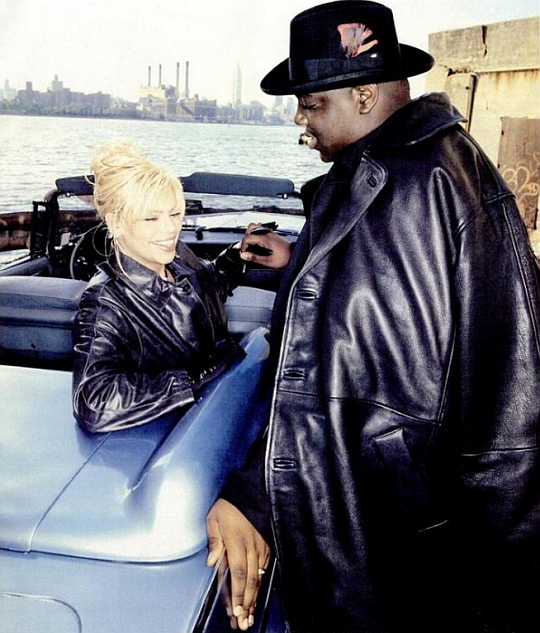
Friday night I went to see the thrilling Jay-Z show at Madison Square Garden. Sitting next to writer/commentator Michael Eric Dyson, he tapped me on the shoulder and asked, "If Biggie had lived, do you think Jay would be the number one answer."
Though I was unable to answer that question, I will say that Biggie was always my favorite, with Jay coming in a close second. Indeed, since I had Biggie on the brain, I thought I'd reprint one of my favorite essays about the man we called Big Poppa...
***
"Life can change in the instant," essayist Joan Didion declared in a recent New York Times article, and nobody understands these words better than a die-hard hip-hop fan. Indeed, in the ever-expanding universe of rap, one blink of the eye and the entire landscape can be different. From street styles to microphone flows to the rappers themselves, nothing lasts forever.
Still, in the case of the Brooklyn boy whose mama named him Christopher, and the rest of the world simply called Biggie, the final change came much too soon. Like the proverbial "gun shot heard around the world", the fatal bullet that killed the Notorious B.I.G. on 8 March 1997 (eight years later, the killer is still on the loose) also transformed the lives of his family, friends, and fans.
A black Buddha of a man born to a 25 year-old schoolteacher mother on 21 May 1972, young Christopher grew up in a time when the city was crumbling in financial decline. From his bedroom window, the husky only child witnessed the grave ills of a community with seemingly no future. It was on these crime-ridden streets of Bedford-Stuyvesant, littered with nodding junkies and abandoned buildings, that the future B.I.G. first witnessed the hard-knock lives that would later lace his street-hardened poetics.
Yet, as B.I.G. went from bubbly baby to sullen teenager to badass man-child surviving in the city of ambition, two things came along that would change his life forever: rap and crack. While the former would make the notorious brother rich and famous, it was the latter — which he sold from his building stoop, but never smoked — that fuelled his witty imagination. The wildstyled "do or die" world of Bed-Stuy ("the place where my head rest") that B.I.G. observed while snapping and squatting on the stoop of his St. James Place apartment would soon become world-renown.
With a deep voice that was gritty as a crack rock and urgent as a siren, B.I.G.'s streetwise poetics and cinematic eye for detail helped a then-stumbling N.Y.C. (having been shoved aside by MCs representing the West coast) get back into the game it had invented in the first place.
Eight years after his death, the master's memory is more alive than ever, evidenced by a recent Rolling Stone magazine feature exploring his unsolved murder and the new Bad Boy Records release The Notorious B.I.G. Duets: The Final Chapter.
On the two studio albums that the Notorious B.I.G. recorded before his untimely death, Ready to Die (1994) and Life After Death (1997), he crafted lyrics that depicted Bed-Stuy as a continuing cycle of chaos, paranoia, and violence. Still, unlike the tales of drugs, guns, and pussy celebrated by West Coast gang-bangers down with the "thug life" (so read the tattoo across the stomach of Biggie's former best friend Tupac Shakur), Biggie's lyrics were simultaneously laced with laughter and tears.
Like the classic ghetto scribes Iceberg Slim and Donald Goines, whose black pulp fiction books were once on every hoodrat's reading list, Big wasn't afraid of showing his human side. In a short, but stellar career that propelled Biggie Smalls "from ashy to nasty to classy", the former Bed-Stuy bully reshaped the sound of New York City rap in a way that hadn't been heard since KRS-One first kicked out the jams in the South Bronx, LL was rockin' bells in Queens, and Kool Moe Dee stomped through the "wild, wild west" of Harlem.
Following in the giant steps of rhythmic '80s icons Rakim and Big Daddy Kane, two of his favorite rappers, the Notorious B.I.G. was determined to stay true to his block and become famous at the same time. After winning the Unsigned Hype competition (March 1992) in the pages of the hip-hop magazine The Source by rapping over an old Kane beat courtesy of his homeboy (and former Big Daddy DJ) Mister Cee, a tape of the massive rapper was sent to A&R rebel and chief conceptualist Sean "Puffy" Combs at Uptown Records.
Having shaped the ghetto fabulous style and grooves of early '90s new jacks Heavy D., Mary J. Blige, Jodeci, and Soul for Real while he was still an intern at Uptown, Puffy dug the dangerous visions on the demo of the 6'3", 200-plus-pound wordsmith. In his article "The Legacy of Big Poppa", Carlito Rodriguez, a former Source Editor-in-Chief and avid rap fan, wrote: "Puffy, liking what he heard though not necessarily what he saw in the dark-skinned, heavy-set young man, decided he could transform him from a raw, thuggish street type into a bona fide class act. Maybe, even a sex symbol."
Taking Biggie from Brooklyn rock slinger to worldwide rock star was not the easiest job on the planet, but Puffy was anxious. After whetting the public's appetite with the club banger "Party & Bullshit" in 1992, a track from the Who's the Man soundtrack, Biggie and Puff's shared vision of bringing Biggie's music to the masses damn near collapsed when Uptown Records CEO Andre Harrell fired Puffy, his former intern.
Harrell later told VH1 about the firing of Sean "Puffy" Combs: "Puffy was a genius in the studio, but outside of it, he was just fast and reckless. With Puffy around, sooner or later something always got broke."
As someone close to the scene, cultural writer Dream Hampton wrote of Puffy's positive spin on the possible setback in The Vibe History of Hip-Hop: "Puff made one of his rare trips to Brooklyn one night. Over strawberry cheesecake, he assured Big that things were going to happen. That their dreams were going to come true. That setbacks are mere challenges and together they would be unstoppable."
Teaming up with veteran music man Clive Davis at Arista Records, the prophetic Puffy officially launched Bad Boy Records, a label that would come to mean as much to hip-hop in the '90s as Def Jam, Tommy Boy, Sleeping Bag, or Cold Chillin' had meant the decade before. Though folks on the street laughed when the lanky man with the master plan had not signed the most attractive MC in history, as usual, Puff would have the last laugh with the signing of Craig Mack and B.I.G.
While Craig's disc Project: Funk da World would be the first released, spawning the dope "Flava in Ya Ear" remix, it wasn't until the following month that Bad Boy truly arrived. Released on 1 September 1994, the Notorious B.I.G.'s revolutionary record, Ready to Die, would become a milestone in hip-hop history.
Biggie and his producers (which included Puffy, Easy Moe Bee, and DJ Premier, among others) crafted an unforgettably brave soul record that was as important to its time as Marvin Gaye's classic What's Going On and Curtis Mayfield's brilliant soundtrack to the classic film Superfly were to theirs.
With an Afro'ed baby on the cover that many fans still believe came from Biggie's mom's photo album, Ready to Die opened with crazy intro of Big's birth and ended with the madness of "Suicidal Thoughts". Separating the game from the truth and everything in between was pure butter.
In the minds of many, listening to Ready to Die was like roaring through the streets of the black metropolis of Bed-Stuy with Biggie as the tour guide. Following in Big Poppa's footsteps, he showed us former gangster days on "Gimmie the Loot" and "Everyday Struggle", shared his "Word Up!" aspirations on "Juicy", verbally screened his personal woman dramas on "One More Chance" and "Me & My Bitch" and revealed raw vulnerability on "Suicidal Thoughts", as well as the title track.
Champagne flowed through his veins; the abyss that separated the Notorious B.I.G. from other rappers (and Bad Boy from other labels) went beyond simply being the best. Incorporated with the "style and grace" of his Hype Williams-directed videos, countless magazine covers and awards, and a hypnotic stage style, Biggie's steady rise from streets to suites caused envy to blister the bitter hearts of his rap rivals.
A storyteller with a unique vision, a wild sense of humor, and a sharp eye for detail, Biggie proved himself special. Even a jaded journalist like myself was sprung; I can clearly remember my late girlfriend Lesley threatening to break-up with me on our Jamaican vacation if I played Ready to Die "one more time".
Nevertheless, in 1995, heated words on records and interviews between B.I.G (and Bad Boy) and his former homie Tupac (and label Death Row) were branded by the mainstream media as an "East Coast/West Coast Rap War". There was enough gasoline thrown on a small flame to start a raging bonfire. Before it was over, both of these talented urban poets were dead.
Assigned by The Source magazine in the spring of '97 (back in the day when the magazine still meant something) to review B.I.G.'s then forthcoming Life After Death, I can still remember the excitement I felt when I put the cassette into the stereo. Sitting in my book-cluttered office early on a Sunday morning wearing headphones and nodding my dome, I was startled when Lesley knocked on the door. With an eerie look in her eyes, I knew there was a problem.
"What's up?" I asked.
"Havelock just called," Lesley answered, referring to my former writing partner and friend. "He said Biggie was killed in California."
For a sick moment, I thought she might be joking, but in my heart I knew she wasn't. Shortly, folks began calling the house, and for the remainder of the day voices cursed and cried as our small community of hip-hop culture watchers mourned another fallen rapper.
Crawling into bed that night I was still shocked and saddened. Before slipping into slumberland, a few tears dripped on my pillow. Only a few weeks prior, when a pack of wild and excited New York music writers crowded into Daddy's House recording studios for an early preview of his sophomore disc, we watched Biggie and Puffy crack jokes, snap pictures with journalists, and show nothing but a lust for life. To hell with being ready to die — at 24 years old, Biggie was just beginning to live. The light in his eyes and the broad smile on his face attested to that fact.
While some folks claim, by evidence of death-tempting tracks like "What's Beef", "Going Back to Cali", and "You're Nobody (Til Somebody Kills You)", that Biggie had a death wish, nothing could have been further from the truth. Shortly after his death, a naïve fan asked me, "Does this mean rap is dead?"
"Hell no!" I screamed. "Jazz didn't die with Charlie Parker, rock didn't die with Jimi Hendrix, and lounge didn't die with Frank Sinatra. Hip-hop might last forever, but all I can think about right now is: Biggie's gone."
Labels: Rap Music, The Notorious B.I.G.