Tuesday, June 19, 2012

Specter Literary Magazine #10 (The Hip-Hop Issue)

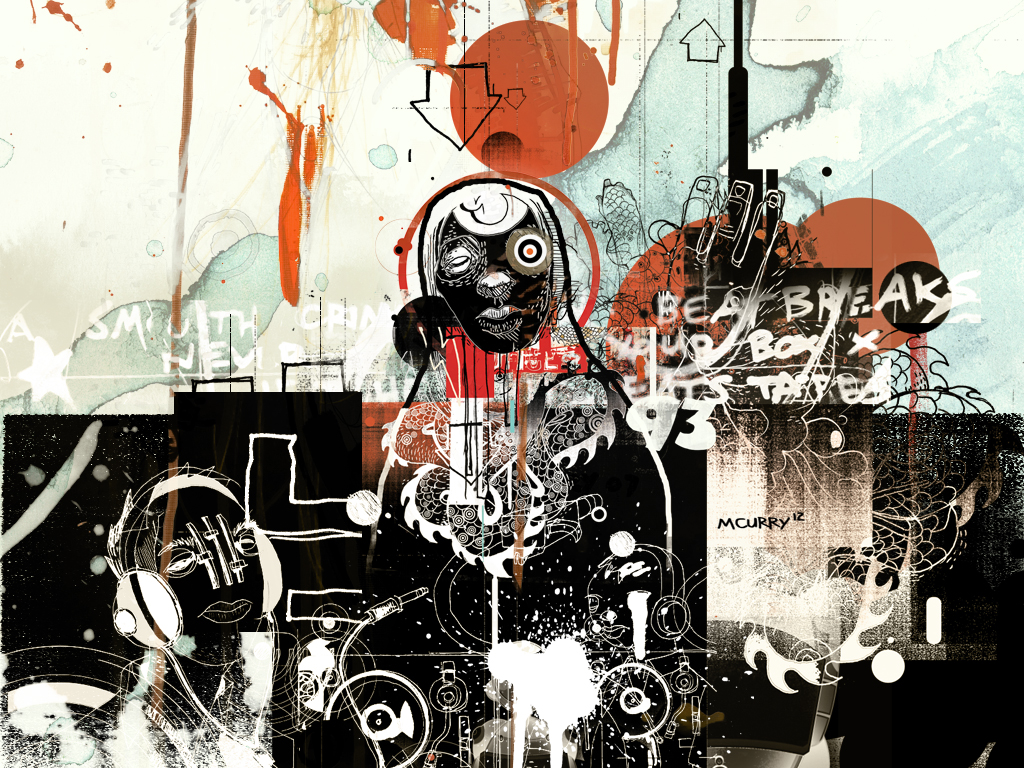
painting by Matthew Curry
copyright 2012


For those who think that Hip-Hop is only about music and style, the editors of the cool online literary journal Specter have a treat for you. With their newest issue, guest edited by writer and teacher Rion Amilcar Scott, Specter attempts to take Hip-Hop Lit to another level. Overflowing with beautiful writing, art and photography, inside you'll find a novel excerpt by Mecca Jamilah Sullivan, poetry by Charlie Braxton, a short story/novel excerpt by me and loads of other textual treats. The wild styled cover art, as shown above, was painted by Matthew Curry, is a masterpiece that should make artists like Lee, Fab Five Freddy and the spirit of Dondi quite proud.

Although folks usually think "Hip-Hop Lit" is all about blood, bullets and broads, the editors of Specter, like KRS-One once rapped, "...think very deeply." Indeed, these young innovators offer a brilliant sampling of cutting edge writing and images that will will elevate your mind and make you happy. If the Rza and Roxanne Shante had a baby, it would be the Specter Hip-Hop Issue. Peace...

Specter Literary Journal #10: http://www.spectermagazine.com

Of Breakbeats and B-Boys by Michael A. Gonzales: http://www.spectermagazine.com/ten/breakbeats

Labels: , , , ,

Thursday, March 10, 2011

Bonz Malone Interview: 2007

Author's Note: This interview was originally published in one of my favorite magazines Stop Smiling Issue 30 in 2007.

Bonz Malone Interview
By Michael A. Gonzales

http://screwtube.files.wordpress.com/2007/07/bonz.jpg?w=490Although pioneering hip-hop scribe Bonz Malone is only a few months shy of forty-years old, it is still hard to believe that we have been friends for twenty of them. Going way back to the early days when hip-hop culture was moving from a New York City novelty to a worldwide industry, Bonz and I met at a Profile Records party for the long-forgotten female rapper L.A. Starr. At that time there were only a few Black writers documenting this musical terrain (including Nelson George, Greg Tate, Barry Michael Cooper and Harry Allen), Bonz was by far the boldest.

Though I read his poetic street rants (at the time, Malone wrote everything in his own special brand of ghetto phonetics) of this Brooklyn based wild-boy in the pages of Spin and the Village Voice, I had no idea he was such a passionate soul. Like a combination of Cameron Crowe (his youthfulness) and Lester Bangs (unafraid of the edge), the man-child who had once tagged trains and worked for a crack cocaine crew kicked in the door of music criticism and refused to leave.

While in real life, punk-ass writers like myself romanticized about the dark side of street life, Bonz not only lived it but he put it into his work. Of course, that gritty bravado sometimes made him a little scary to be around, but we were all a little richer for the experience.

Everybody that was around in those early days has a Bonz Malone story; in the rap-set world that we travel in, more than a few have even morphed into urban legends that rival alligators in the sewer. There was Bonz throwing M-80s after a 3rd Bass concert at the Beacon, there was Bonz handing in stories handwritten on loose-leaf, there was Bonz bombing the system one day and partying with Russell Simmons’ the next.

A ghettocentric renaissance man who has written wonderful articles, guest-starred in acclaimed films (Slam) and signed Mobb Deep to their first deal, Bonz Malone put a certified stamp of truthfulness on every endeavor. In Malone’s life and work, the main thing one could count on was his brilliance.

***
Michael Gonzales: First, where did the name Bonz come from?

Bonz: Well, there were two meanings. The first being that ‘bonz’ represented the skeletons in the closet. You know, those things we had done in the past. I would tell people, if you open my coffin a hundred years from now, that’s what you will see, bones. That’s the realest shit. So, when I started writing graffiti, that was the name I chose.

MG: What was the other meaning?

Bonz: (laughs) It also stood for Black Fonz, because I always saw myself as the
Fonzie nigga. Henry Winkler was a dope dude. How many Jewish actors you know can play an Italian better than real Italians?

MG: What was your hip-hop experience that made you want to be down?

Bonz: Man, it was the night that Wild Style opened in Times Square in 1983. I was 12 years old, and I had to wait for my grandmother to go to sleep so I could sneak out. I put my life on the line, but it was worth it. The theater was so crowded, I had to sit on the stairs. And, the whole movie was in the audience. I saw Grandmaster Caz, Rock Steady, Grandmaster DST and Lee.

MG: I know you wrote graff for years. What was that like?

Bonz: That’s the first element of hip-hop. Man, bombing trains was what I loved to do, that’s who I am. Even today, I have to fight myself not to write on the train. I never did any of those huge masterpieces outside the train, but I tagged in the train. Once we moved to Brooklyn, I was doing the 2’s and 5’s. Those trains went through the South Bronx, so people knew my name.

http://www.graffnews.com/wp-content/uploads/2008/04/phase2-subway-graffiti.jpg

MG: You went from writing on walls to typing on paper. Talk about that transition?
Bonz: I started writing for the high school newspaper and Bill Adler, who was then the publicist at Def Jam, saw my clips and hooked me up with Spin magazine. The first professional piece I wrote was a review was a review of De La Soul’s 3 Feet High and Rising.

One of the things that made me what to write for print was reading Jimmy Breslin in The Daily News, because I didn’t like the way he wrote about the Black community in New York City. Breslin stirred a lot of racial shit in his columns, and it was obvious he knew nothing about Black people. Through my writings, I wanted people to know who were and the beauty that hip-hop represented.

MG: Were you paying attention to other hip-hop writers of that period?

Bonz: I was aware of the others like you and Harry Allen, but I wasn’t really paying attention. I was working with John Leland and Joe Levy, and both of those guys taught me a lot. I considered my work to be graffiti writing in print. They later gave me a column (Radio Graffiti), but it was real sporadic because I kept getting locked-up. Every magazine I’ve written for—Spin, The Source, Vibe-have all bailed me out of jail at one time or another.

MG: What is your favorite album from that golden period?

Bonz: To me, the number one hip-hop album is Public Enemy’s It Takes a Nation of Millions to Hold Us Back (Def Jam, 1988). When that fucking record dropped, I thought the end of the world was coming. I worn gray and black everyday. The first time I heard that record, I almost cried. Nothing made today could go up against that one disc. Nothing.

http://www.theprogram101.com/wp-content/uploads/2010/07/public-enemy-it-takes-a-nation-of-millions-to-hold-us-back-album-cover-300x298.jpgSS: Didn’t you and Chuck D. get into a little thing back then.

Bonz: Yeah, because he dissed me for no reason. He called me a “house nigger,” because I wrote for a white magazine. Hell, there weren’t any real hip-hop magazines out then, but he was mad because I was writing about rap in a rock magazine. We talked about it later, and now we have nothing but respect for one another.

MG: At one time rappers talked the world, now they just talk about themselves.

Bonz: You’re so right.

MG: After your Spin days, you went over to The Source.

Bonz: Originally The Source was a college fanzine, but when they decided to move to New York and become a glossy, they contacted me over at Spin. I wrote a Queen Latifah cover story, I wrote a Tribe Called Quest cover story and I wrote the first Biggie story. We didn’t make much money, but we sure got a lot of free t-shirts.

MG: Talk a little about your time as rap A&R at Island Records under Chris Blackwell.

Bonz: That was in the early ‘90s. I almost signed Biggie. We lived two blocks away from each other. I had heard his demo around the same time Puff was trying to sign him. Biggie told me if I won a craps game, he would sign with Island instead. We shot dice on the roof of Island Records for three hours, but I lost.

MG: But, you did sign Mobb Deep.

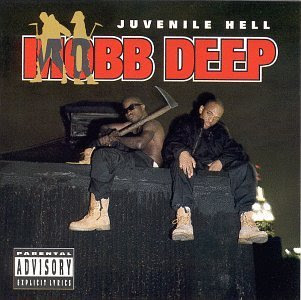
Bonz: My man Matty C. ran the “Unsigned Hype” column at The Source. He played their tape for me, and in the first eight seconds, I wanted them. Nobody was making that kind of music except NWA. Nas hadn’t even come out yet. To me, Mobb Deep was the NWA of the East Coast.

https://blogger.googleusercontent.com/img/b/R29vZ2xl/AVvXsEhfMmgs1imunVdcZ7n8mcf41bCNvjMToYsvomO0YEHbZ4gtFLx9OuvLjDIb7y3Eb8br6UOmCPSYGcPgwJYQAlFcAXsbuX9eVo5TFozmYBwvULe-xwUqntVziMBhu4deQTGGHoWh/s400/Mobb-Deep-Juvenile-Hell.jpg

MG: I know you worked for and partied with Russell Simmons years ago. Any insights?

Bonz: I liked Russell better when he was broke. He was cool and hungry, and not so self-absorbed. Russell has done many things for many people, but I’ve seen him become an asshole.

MG: What are some of the stories you’ve written that stand out?

Bonz: I covered the 1987 Grammy Awards for Spin; when Millie Villnilli won for Best New Artist, I almost got thrown out for screaming, ‘Ya’ll can’t even sing!’ as they were walking-up to the podium. Later, when I was writing the story, I said Dick Clark’s teeth were made of wood. As far as the rap side, I guess it was going to the studio to interview De La Soul, because they gave me a copy of 3 Feet… before it came out. At that time, something like that meant a lot.

MG: I know you kick-started your acting career with a part in Slam (1998).

Bonz: Yeah, I had been friends with Marc Levine for a long time. Originally, I was supposed to star in that movie, but, once again, I was in jail. I had introduced Marc to Saul Williams, so he got the lead instead. I wasn’t, mad, because I still got another part in the movie. That film changed our lives.

MG: What do you think about hip-hop culture in 2007?

Bonz: Rap music is a joke these days. It’s not hip-hop culture, its rap life. Rap life is more concerned with what it can get for itself, not what it can contribute. These niggas just want to make money, but they have very little to offer. I come from an era when rappers didn’t even curse, now you got all these cats cussing instead of rhyming.

MG: What about hip-hop writing?

Bonz: I have respect for everybody, but it was always my thing to be the best motherfuckering writer there was. I feel like I blasted the door open for a lot of people. A lot of writers today barely know there history, while other so-called ghetto lit writers like Relentless Aaron is just using writing as a hustle.

To paraphrase (graffiti artist) Iz the Wiz, a writer is somebody you want to write with or fight with; those words are burned into my heart.

Labels: , , , ,

Wednesday, January 19, 2011

On Ernie Paniccioli's Graffiti Photos

"Urban Blight: the Graffiti Photographs of Ernie Paniccioli"
An Essay By Michael A. Gonzales

Note: This 2004 essay was written for my friend Ernie Paniccioli's photo exhibit at Bill Adler's now defunct Eyejammie Gallery.


Since the beginning of recorded history, New York City has been a haven for outlaws. From the hard-knock characters lurking in the Lower East Side of Herbert Asbury’s seminal "Gangs of New York" in the 1840s to the Mafia families in the 1940s to the grimy gangs trooping through the Bronx in the 1960s, we have often romanticized the dirty deeds of these urban desperadoes.

Coming of age in the heart of Harlem during the late Seventies, when hip-hop culture was so young it didn’t even have a name, I witnessed another kind of outlaw emerging from the rubble of a bankrupt city. Calling themselves "writers," these kids could have cared less about composing The Great American Novel or a Marxist manifesto. Their writing was done with spray-paint, using vibrant colors that illegally "defaced" public spaces and private property. Armed with cans of Krylon, Red-Devil or Rustoleum that had been stolen (or "racked") from the local Woolworth’s or hardware store, these visual vandals created multicolored spectacles on the surface of subway cars and ghetto walls.

Standing on the elevated 125th Street subway station, where the beat-down IRT #1 train ran, it was always a joy to see the aged steel cars creep down the tracks gleaming with a fresh piece of writing. These massive and moveable artworks were illustrated proof that yet another beautiful art form, like jazz or the Charleston, had been birthed out of the brutality of the hood.


Ernie Paniccioli and Eyejammie's Bill Adler

Although these works were immediately celebrated by enthusiasts of the graff genre as genius, many New Yorkers were less than enthusiastic. Irate parents, cops, and the court jesters running city hall were in agreement that these rebel writers were simply criminals destroying property. Of course, within the tribal universe of graff crews, writing was like breathing, and as long as there was a steady flow of paint -- sunset orange, jungle green, empire blue -- the world was a perfect place.

With names like Lee and Dondi, Vulcan and Blade, many of these talented kids were unhindered by the codes of surrealism, futurism or post-modernism. Yet whatever they lacked in formal education and museum visits, they made up with an overflow of vivid ideas, crazy styles, boundless energy, and badass swagger. In any case, if comic books had been a respectable influence for Warhol and Lichtenstein in the Sixties, they were certainly good enough for the graff kids a decade later. By the early Eighties, when a new generation of art world stars emerged -- including such new-jack painters as Jean-Michel Basquiat, Keith Haring, Gary Panter and Kenny Scharf – it was clear that they were equally influenced by Warhol and the first great graff writers.

Ernie Paniccioli was recently discharged from his service in the Vietnam War and nearly thirty years old when he peeped his first graff crew chilling at the infamous Writer’s Bench in the subway station at 149th and the Grand Concourse. "What blew me away about these kids was how true their work was," Paniccioli says. "Looking at one piece, I could pick up on their magic, pain, anger, frustration and fear. I was also deeply impressed by their commitment. They risked being bitten by transit dogs, electrocuted on the third rail, and beaten-up by rival crews. They gambled everything just to do their art."

Of course, for many of the wild boys sneaking into the treacherous train yards at night, graff seemed like the only way of announcing their presence to an indifferent planet. "These kids kids barely existed for most of society," Ernie notes. "Unless it was thugs in handcuffs on the six o’clock news or a PBS special about the failing school system, no one paid them any attention. Graffiti was a way for them to scream. With graffiti, they were somebody."

Like his graffiti-snapping peers Martha Cooper and Henry Chalfant, Paniccioli was one of the very few photographers allowed into the inner sanctums of these subterranean style warriors. Laughing, Ernie recalls, "When I first started hanging around, a few of the kids thought I was a cop, so they would run away. After a while we got to know each other, and they trusted me enough to tell me where they would be bombing. Believe me, I took it as a great honor that these guys invited me into their world."

Photographers Jamel Shabazz, Martha Cooper, Ernie Paniccioli and director Charlie Ahearn

In 2004 New York City is a completely different kind of metropolis. The trains have changed, hip-hop has become a multimillion dollar business, Times Square has been redesigned as a theme park, and the once dangerous and decadent spirit that hovered over the concrete jungle, influencing a wide range of innovators, has seemingly disappeared.

Yet, while the furor for writing might not be as intense as it once was, there are new graff kids on the block trying to keep hope alive. These days Ernie Paniccioli can still be seen shooting pictures on the streets of the city...any city. Be it New York or Sao Paulo, Brazil (where, in February of this year, several of this show's images were shot), the brother is still doing it.

His work is important not only for its own sake, but because it preserves the work of the graff crews. "No matter how long they planned and worked on their pieces, the writers were well aware that the next day it might be scrubbed away," says Ernie. Indeed, as homegirl Susan Sontag has scribbled in another context, Ernie's work confers "kind of immortality" upon these transient masterpieces.

(Pictured below: Postcard for "Urban Blight". Mural by Team, 1985. Photo by Ernie Paniccioli.)


Labels: , , , ,